Topic Clusters & Internal Linking Strategy: A 2026 Guide to Site Architecture That Ranks
目次
Key Takeaways: Site Structure Is Your SEO Foundation
-
Topic clusters are a useful structure in the AI search era — A pillar-plus-cluster structure organizes a topic systematically, which helps search engines and AI answer systems discover and make sense of your coverage. Figures such as "roughly 30% more organic traffic" and "2.5x longer ranking retention" are widely quoted, but we could not verify their sources — treat them as directional.
-
The 3-click rule keeps your architecture flat — Place every important page within 3 clicks of the homepage. Pages buried deep in the hierarchy have thinner internal-link pathways, so both crawlers and readers reach them less often.
-
Internal links concentrate link equity where it matters — Strategic internal links from high-authority pages to revenue-critical pages can outperform a low-quality external backlink (an observation from our own work, not a verified general rule). The sweet spot is 2–5 contextual links per 1,000 words.
-
Page pruning raises your site's quality density — Removing or noindexing thin, zero-traffic pages saves crawl budget and lifts the remaining pages' evaluations. Google's August 2024 core update rewarded sites that pruned low-quality content.
-
Design → Implement → Measure in a continuous cycle — Topic cluster impact is measurable through A/B tests and staged rollouts. Combine Google Search Console, GA4, and crawl data to track impressions, clicks, CTR, and rankings.
The sections below walk through each theme in detail.
1. What Are Topic Clusters? The Pillar Page Concept Explained
How does a topic cluster actually work?
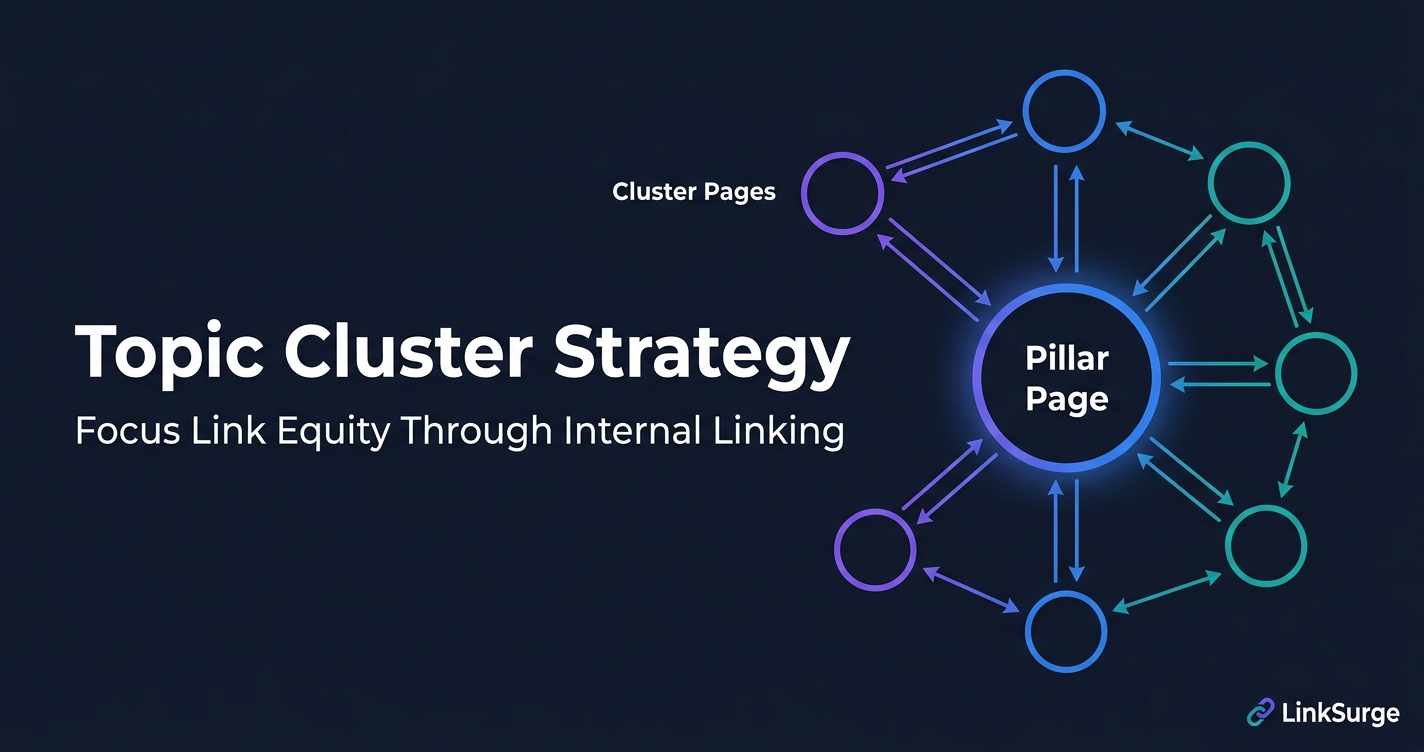
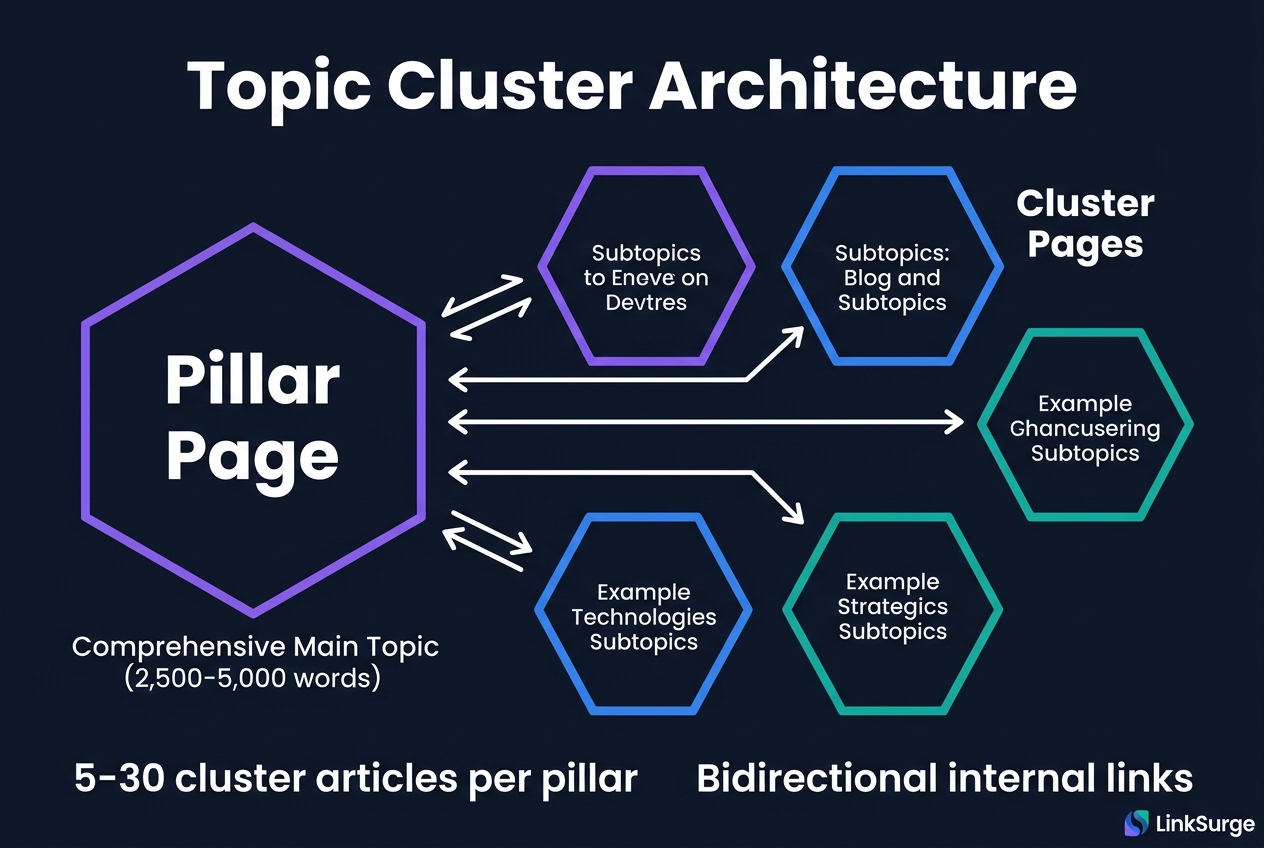
A topic cluster is a content architecture where a single comprehensive pillar page (the hub) links to — and is linked from — multiple cluster pages (the spokes), each covering a specific subtopic. This hub-and-spoke model helps search engines and AI systems recognize that your site thoroughly covers a topic.
What struck me about the 2025–2026 research is how consistently this structure outperforms traditional flat blog approaches. It's not just a Google ranking factor anymore — AI answer engines like Google AI Overviews, ChatGPT, and Perplexity actively favor sources that demonstrate comprehensive topical coverage.
What makes a strong pillar page?
The practical recommendation is to create pillar pages as comprehensive guides of 2,500–5,000 words. They serve as a "table of contents" for the topic, linking to each cluster page. Cluster pages, in turn, dive deep into specific subtopics and always include a link back to the pillar.
The number of cluster pages per pillar varies by topic breadth — typically 5 to 30 articles. What matters is coverage completeness, not hitting a specific number.
Our Complete SEO Guide for 2026 covers the full SEO landscape, but site architecture is arguably the technical backbone that everything else depends on.
References: Pillar Pages & Topic Clusters for SEO Growth 2026 - Web Spider Solutions The complete guide to topic clusters and pillar pages for SEO - Search Engine Land A Topic Cluster Content Strategy for 2026 - Brafton
2. Why Flat Architecture Wins — The 3-Click Rule
What's the evidence behind the 3-click rule?
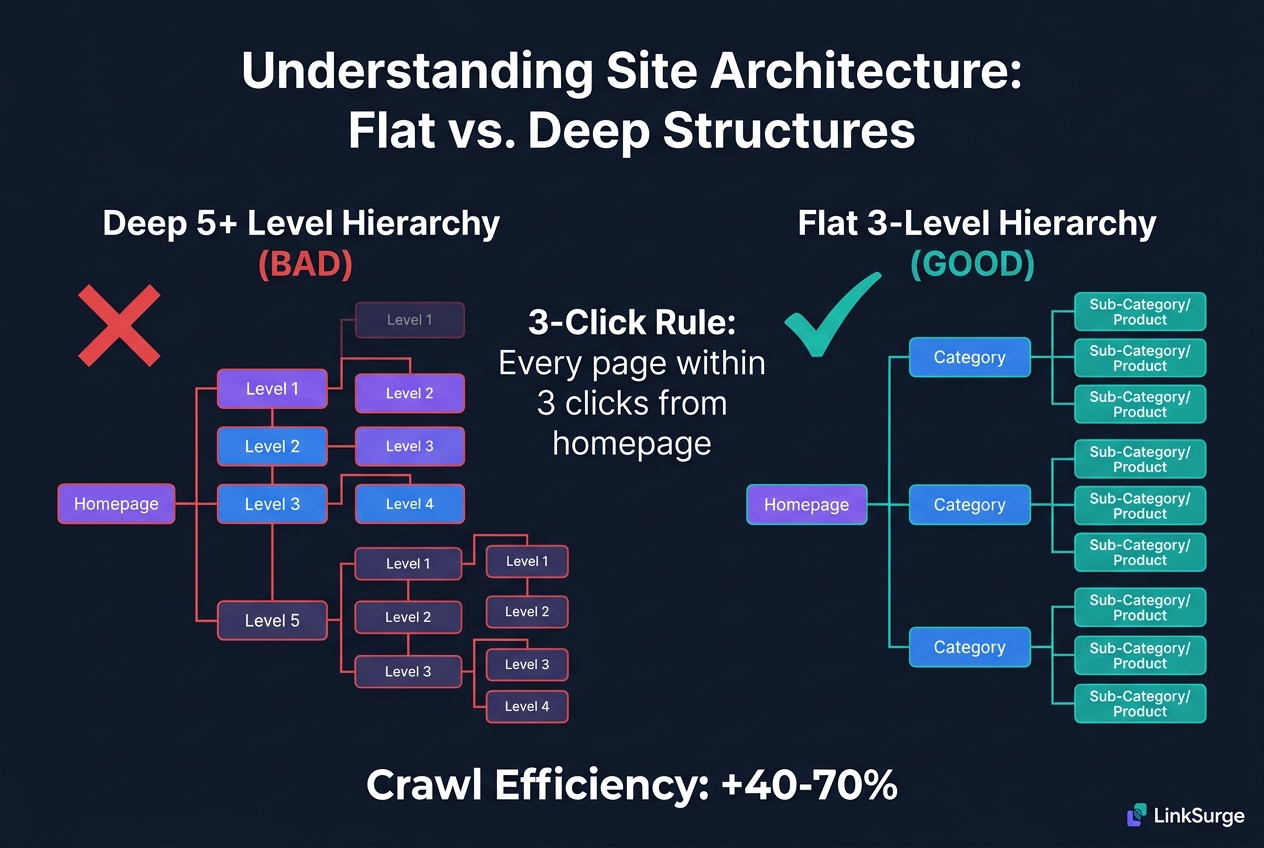
The 3-click rule means every important page on your site should be reachable within 3 clicks from the homepage. It is a UX convention and an architectural one: it affects how easily both crawlers and readers reach a page.
Here's the thing: pages buried deep in a hierarchy are harder for search engines to discover, because the further a page sits from the homepage, the thinner its internal-link pathways become. Google's crawl budget guide states that "URLs that are more popular on the Internet tend to be crawled more often" — note that it does not name PageRank. Treat "depth 4" as a rough heuristic rather than a ranking threshold. You will also see "40–70% improvements in crawl efficiency" quoted for flat architectures; we could not identify the underlying study, so treat that as a directional figure.
Practical tactics for flat architecture
To keep your site hierarchy shallow:
- URL design: Use 2–3 level structures like
/category/subcategory/article/ - Breadcrumbs: Mark up with BreadcrumbList structured data to reinforce hierarchy signals
- Global navigation: Provide links to major categories across all pages
- Contextual links: Place natural in-content links to reduce effective click depth
LinkSurge's SEO analysis dashboard helps you visualize your site structure and identify pages with click-depth issues.
References: Internal Linking Strategy: Complete SEO Guide for 2026 - Ideamagix Internal Linking Strategy 2026: Site Architecture That Ranks - Mavic Labs Best Internal Linking Strategy for SEO 2026 - Data Enriche
3. Concentrating Link Equity Through Internal Links
How does link equity flow through internal links?
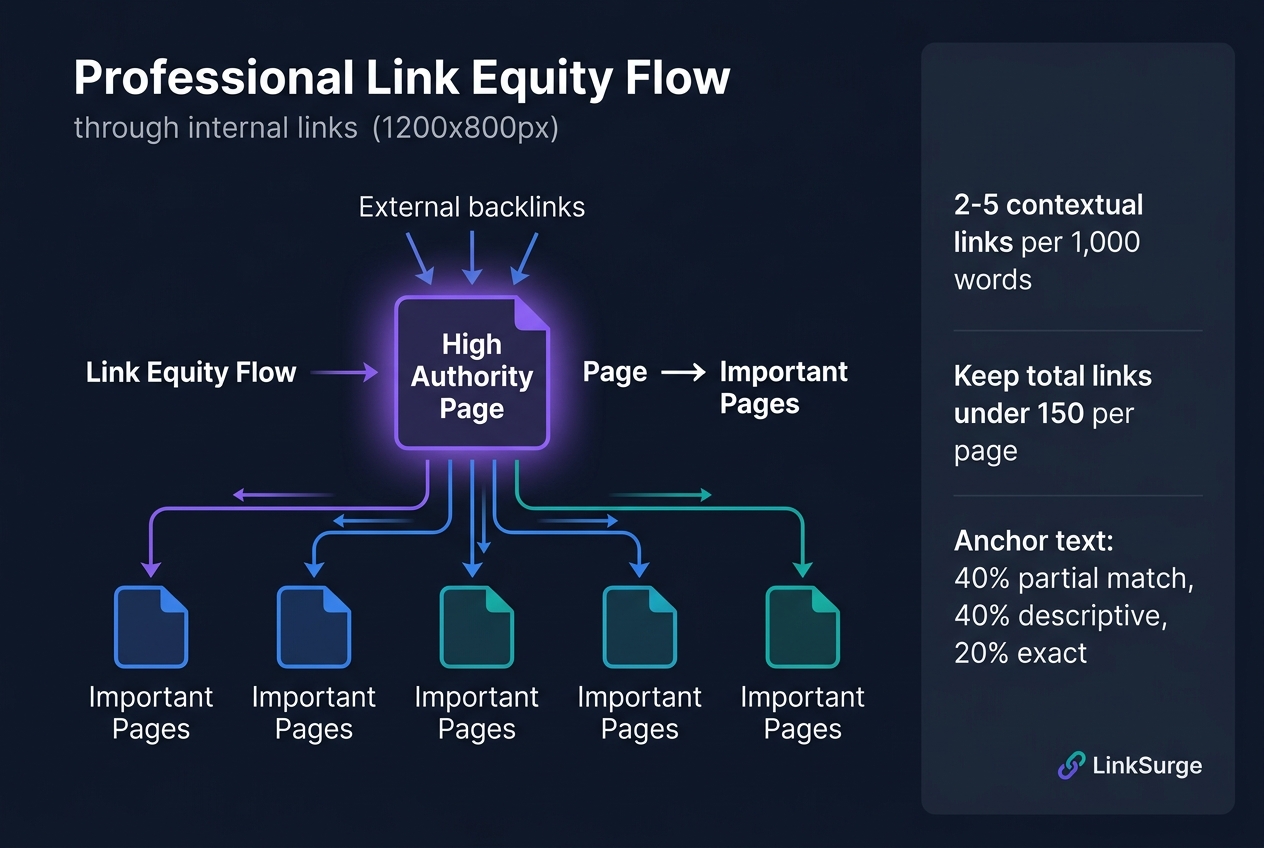
"Link equity" is the SEO industry's shorthand for the ranking weight that flows between pages through links.
It is often treated as a synonym for PageRank, but they are not the same thing. PageRank is one of many ranking systems Google operates; it did not go away, only the public score did (Gary Illyes). Link equity, by contrast, is an industry-side label for those mechanics collectively — not a metric Google publishes. Google also describes links as signals for understanding relevance and discovering pages, so an internal link does not mechanically transfer ranking power to its target.
Honestly, internal linking feels like one of the most underutilized levers I see. I've watched target pages climb after nothing more than adding internal links from backlink-heavy blog posts to product pages.
That is an observation from sites I have worked on, though — not a verified general rule that one internal link beats one low-quality backlink. What an internal link reliably buys you is discoverability and a relevance signal from the linking page.
Optimal link volume and anchor text
A common rule of thumb is 2–5 contextual links per 1,000 words.
You will often see a hard cap quoted for total links per page. That number traces back to the "about 100 links" line in Google's old webmaster guidelines, which has since been removed; Google has said it was never a technical limit. You will also hear that equity per link thins out as you add more. That comes from the original PageRank formula, not from verified current behavior. The practical concern is simpler: too many links make it hard for a reader to know which one to follow, so keep the emphasis on in-content contextual links and stay within what a reader can actually follow.
The principle for anchor text is simple: make it describe what the reader will find on the other end. Avoid "click here" and "read more," which say nothing about the destination.
You will see recommended ratios for exact-match versus partial-match anchors. That framing originated in the context of external backlinks and penalty avoidance. Google publishes no distribution rule for internal anchor text, and there is little basis for transplanting the external-link ratios here — so this guide does not prescribe one.
Three-directional linking within clusters
Inside a topic cluster, combine three link directions:
- Downward (Pillar → Cluster): The pillar links to each cluster page
- Upward (Cluster → Pillar): Each cluster page links back to the pillar
- Lateral (Cluster ⇄ Cluster): Related cluster pages link to each other
This three-directional structure strengthens topical cohesion, helping search engines recognize the entire cluster as a single topical authority.
Our guide on Off-Site SEO and GEO explains external link strategies worth designing alongside internal linking, so that pages accumulating backlinks have clear pathways into the pages that matter to you.
References: Internal Links SEO Best Practices - Moz Google's Matt Cutts: We Dropped The 100 Links Per Page Guideline - Search Engine Land(the origin of the "links per page" cap, and its removal) Google's Gary Illyes: We're Still Using PageRank - Search Engine Roundtable(PageRank remains in use internally) How many internal links should you have per page? - InLinks Internal Linking for SEO: Complete 2026 Guide - LinkWhisper

LinkSurge
linksurge.jp
SEO・AIO・GEO統合分析プラットフォーム。AI Overviews分析、SEO順位計測、GEO引用最適化など、生成AI時代のブランド露出を最大化するための分析ツールを提供しています。
4. Building Topic Clusters — A 5-Step Framework
How should you design a topic cluster from scratch?
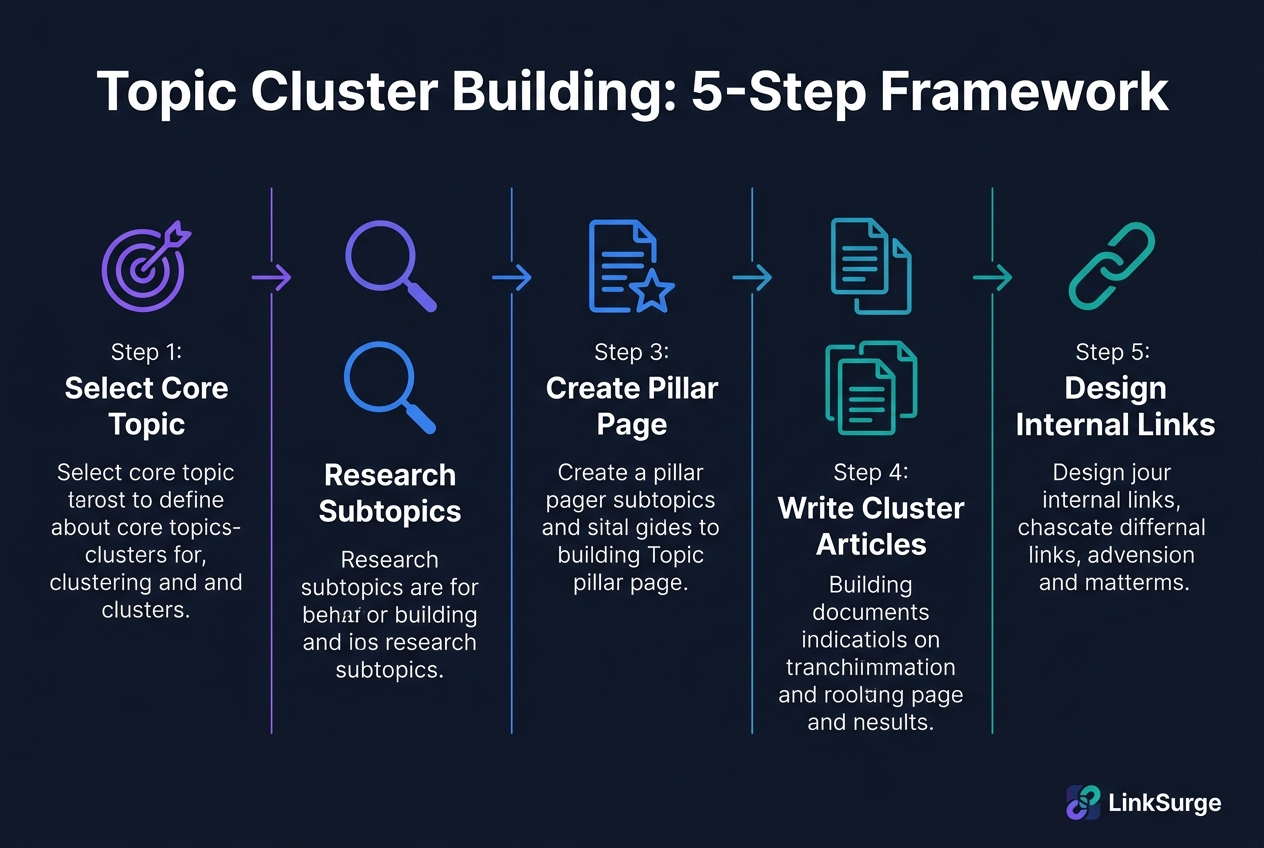
Let me walk you through the practical 5-step process.
Step 1: Select your core topic
Choose a single topic central to your business. For an SEO platform, "SEO strategy" could be the core. Selection criteria: search volume exists, it's business-relevant, and it can be broken into sufficient subtopics.
Step 2: Research subtopics
Break the core topic into subtopics with distinct search intents. Use keyword research tools to check volume, competition, and intent for each. Aim for 5–30 subtopics per pillar.
Step 3: Create the pillar page
Build a comprehensive 2,500–5,000 word guide that covers the topic's full scope. Include an overview of each subtopic with links to the corresponding cluster pages.
Step 4: Write cluster articles
Create in-depth articles for each subtopic. Each article must include a link back to the pillar and lateral links to related cluster articles.
Step 5: Design and implement internal links
Review the entire cluster's link structure. Check for broken links and orphan pages. Use Google Search Console's internal links report to monitor distribution over time.
LinkSurge's keyword analysis features streamline Step 2 — you can research search volume, competition, and intent across all your subtopics in a single workflow.
References: Topic Clustering Guide: Build Authority with Pillar Pages in 2026 - ClickRank How to Build Pillar Content: A Step-by-Step Guide 2026 - NiuMatrix How To Boost SEO and DR in 2026 With Topic Clusters - StoryChief
5. Page Pruning — Criteria and Execution
Why is page pruning necessary?
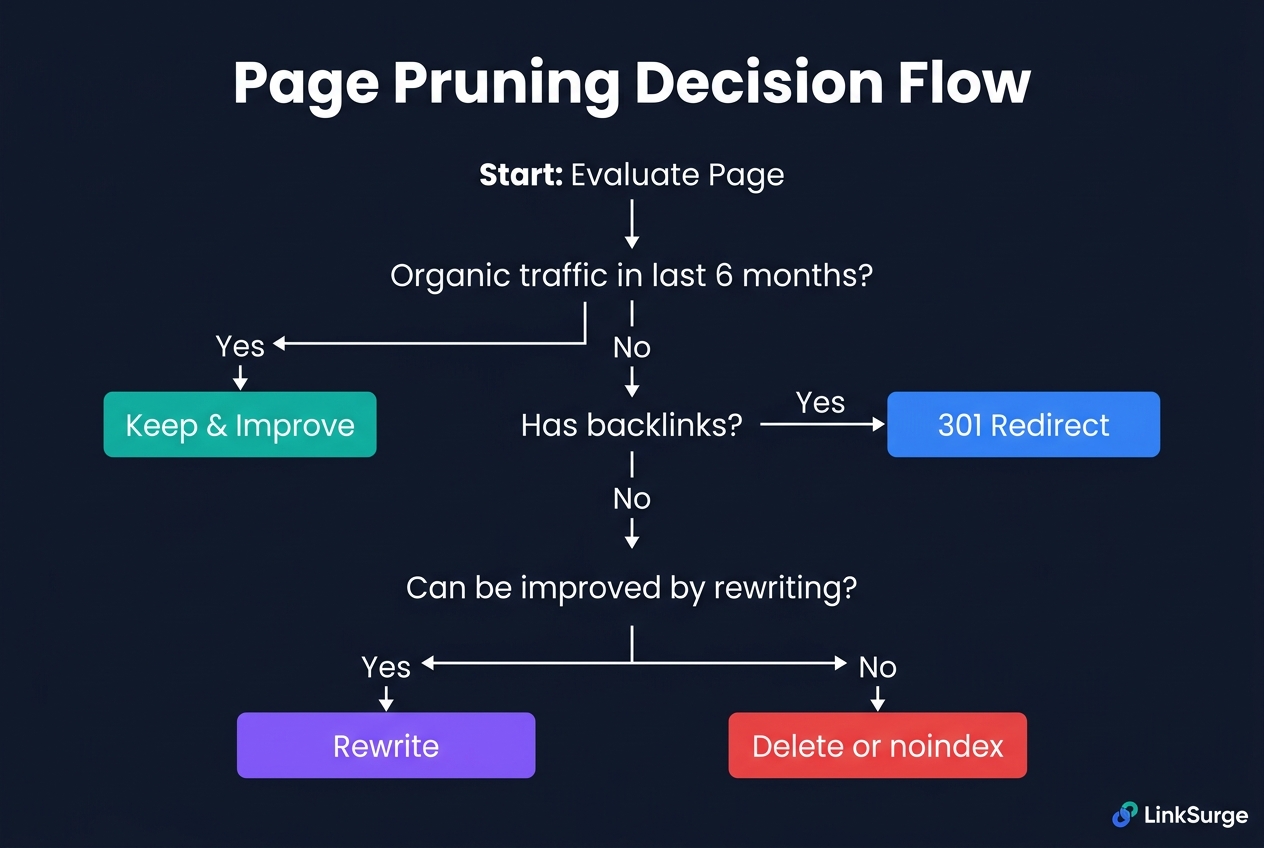
Page pruning (content pruning) means removing, consolidating, or noindexing underperforming pages to raise your site's overall quality density. Here's why it matters: search engines evaluate your site's overall quality. A high proportion of thin pages can drag down even your best content.
Google's August 2024 core update delivered clear evidence — sites that pruned low-quality content saw ranking improvements for their remaining pages. Removing thin pages from the index can actually make your other pages rank higher.
Four actions for deciding
Categorize each page into one of four actions. (This guide labels them KUMD — Keep / Update / Merge / Delete — as shorthand; it is not an established industry term.)
- Keep: Low traffic but contributes to conversions or has backlinks
- Update: Outdated content on a valuable topic → rewrite it
- Merge: Multiple pages covering similar themes → consolidate into one, 301 redirect the old URLs
- Delete: Zero traffic, no backlinks, no improvement potential → return 410 status (see below on choosing between 410 and noindex)
Specific criteria to evaluate
Combine these data points for each page:
- 6–12 month organic traffic: Identify pages with zero impressions/clicks in GSC
- Backlink profile: Check with Ahrefs/Moz — don't casually delete pages with backlinks
- E-E-A-T assessment: Outdated, thin, or inaccurate → pruning candidate
- Cannibalization check: Are multiple pages competing for the same keywords?
Noindex vs. deletion
Noindex: Page stays on your site but is removed from search index. Best when users might still access it directly or via site navigation.
Delete (410): When the page serves no purpose. The 410 status code signals intentional removal to Google.
301 redirect: When the page has backlinks or you're merging similar content. Preserves link equity.
References: Index Bloat Is a Powerful SEO Fix You Need in 2026 - ClickRank What to know about our August 2024 core update - Google Internal Linking Structure: The Ultimate 2026 SEO Guide - ClickRank
6. How to Treat the Numbers People Quote
How much impact do topic clusters really have?
These are the figures that circulate in SEO write-ups and vendor reports on topic clusters.
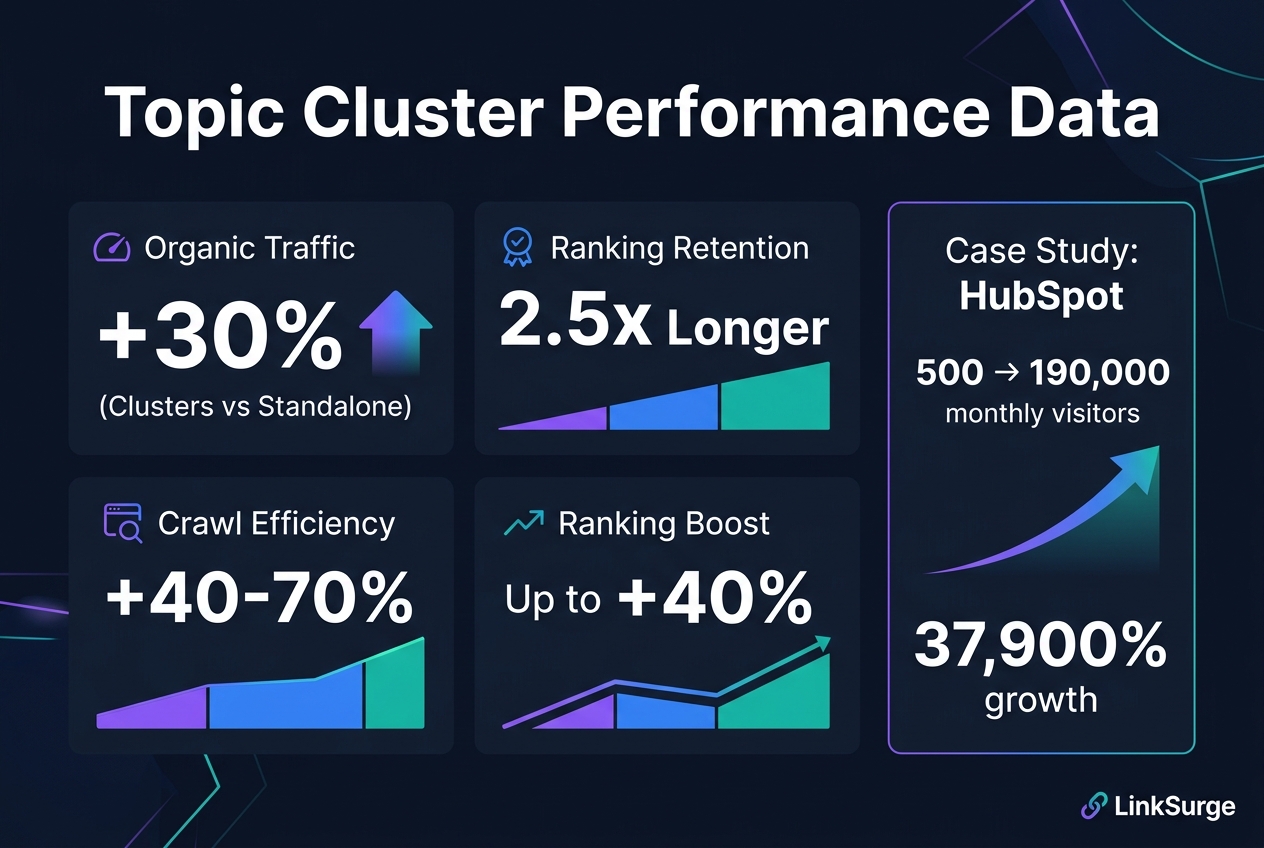
Caution: for each of the numbers below, we have not been able to verify the underlying study, its sample, or its methodology. Treat them as directional, not as a basis for your own targets or KPIs.
| Metric | Impact |
|---|---|
| Organic traffic | ~30% more vs standalone posts |
| Ranking retention | 2.5x longer |
| Crawl efficiency | 40–70% improvement |
| Ranking boost | Up to 40% |
| 12-month sustained growth | 40%+ traffic increase |
Connection to Google core updates
Following Google's 2024 core updates (March and August), many sites reported heavy traffic losses. We have not found a study that attributes those losses to site architecture, though. Core updates are a broad reassessment of content quality, and structure cannot be isolated as the cause — so this guide cites neither the drop percentages nor a causal explanation.
The June 2025 core update doubled down on topical authority — rewarding sites that cover subjects thoroughly, consistently, and credibly.
How to measure cluster performance
Track these metrics at the cluster level:
- Cluster SOV (Share of Voice): Visibility share for your target keyword group
- Impressions, clicks, CTR, average position: From Google Search Console
- Internal link CTR: How often links within the cluster get clicked
- Conversions: GA4 conversion tracking through cluster entry points
Our SEO in 2026: Beginner's Guide covers these measurement methods in greater detail.
References: How Pillar Pages Work: B2B SEO Strategy Guide 2026 - Whitehat SEO SEO Content Clusters 2026: Topic Authority Guide - Digital Applied Topic Clusters for SEO: The Ultimate Strategy for Organic Growth in 2026 - EmbedPress
LinkSurge
linksurge.jp
SEO・AIO・GEO統合分析プラットフォーム。AI Overviews分析、SEO順位計測、GEO引用最適化など、生成AI時代のブランド露出を最大化するための分析ツールを提供しています。
Frequently Asked Questions
Do topic clusters work for small sites?
Yes — small sites often see faster results. Start with one pillar and 5–8 cluster articles. Complete one cluster fully and measure its impact before starting the next. The internal linking improvements alone can deliver quick wins.
Won't page pruning cause traffic drops?
There may be short-term fluctuations. But with proper safeguards — checking backlinks, setting up 301 redirects, and implementing changes gradually — you'll typically see crawl and index improvements within 2–4 weeks. Start with obviously zero-traffic pages and avoid mass deletions.
Is more internal linking always better?
There is no defined cap. The commonly quoted "100–150 links per page" traces back to a line in Google's old webmaster guidelines that has since been removed, and Google has said it was never a technical limit. The "equity per link thins out" explanation comes from the original PageRank formula rather than verified current behavior. What does hold up is that too many links make it hard for readers to know which to follow, so use 2–5 contextual links per 1,000 words as a working guide. Header and footer links appear identically on every page, so they carry no signal that a given page is especially related to the target. That is the reason to prioritize in-content contextual links.
Can I reorganize existing content into topic clusters?
Absolutely — and it's highly effective. Start by auditing all your content and grouping it by theme. Select (or create) a pillar page for each group, then redesign your internal links. This reorganization alone tidies up the pathways into your important pages, making them easier for crawlers to reach and for readers to move between.
Next Steps: Start Restructuring Today
Topic clusters and strategic internal linking are among the highest-ROI SEO investments you can make in 2026. With AI search engines prioritizing topical authority, building content as interconnected clusters — not isolated posts — is no longer optional.
Start by auditing your current site structure. Use Google Search Console's internal links report to find pages with concentrated links and orphaned pages. From there, select one core topic to cluster, aim for a flat hierarchy reachable within 3 clicks, and don't forget to prune the thin pages that dilute your site's quality signal.
LinkSurge's SEO Analysis Dashboard lets you run keyword analysis, competitor research, and site structure audits in one place — supporting data-driven decisions from cluster design through performance measurement.